All posts by Raschelle Holland

Short Form Opt Out Letter to My Son’s Principal

February 8th, 2015

Dear Mr. D,

I would like to begin this letter by commending H Elementary for the education my son has been offered to this date. He has had a wonderful experience with both of his teachers. Their ability to communicate with me about my son’s progress has been consistent, clear, and based on classroom evidence. This classroom based evidence is the most critical component in showing me the strengths of my child as well as the areas to focus upon for future improvement.

I have concerns with the SBAC test and I do not believe it will measure what my son really knows and understands. Many of the questions on the SBAC I believe are developmentally inappropriate. I personally took the practice test and it was an eye opener.

I am writing this letter to opt my son out of the following tests:

  1. Although my son is in 2nd grade, I wanted to establish my legal right to opt him out of the SBAC test in his 3rd through 6th grade elementary career.  (If it still exists).
  2. If H is considering giving the end of the year 2nd grade Interim Amplify Test, or any portion of the Amplify Test, I am utilizing my parental right to opt him out of all Amplify Testing. I am a proponent of classroom based assessments and classroom based evidence of his learning.  Computerized assessments at young ages do not typically show what a child truly knows and understands.  I trust his teacher completely to share his academic growth.
  3. I believe my son missed the WaKids assessment as he was not full day Kindergarten.  For this, I am very thankful. I will be opting him out of all like assessments that involve survey questions regarding his emotional health, his feelings, his thoughts on bullying, sex, drugs or the like.   As a parent, it is my responsibility to educate my son on these matters.   I do not want him to participate in these surveys.

My son is a bright, intelligent, curious boy.   What I value most in education for his age group happens within the walls of his classroom.   His teacher is the expert and knows him extremely well.  I honor her expertise above any mandate, policy, flawed curricular materials, and especially a standardized test.

I sincerely thank you for taking the time to read this letter of concern and my decision to opt my son out of testing.

With the Utmost Respect,

Parents

My Son is More Than a Score…My Reasons for Opting Out of Testing

Information of how to go about opting your child out of the testing can be found (here).

I emailed the following rational for opting out of testing to my son’s principal.  The next day I sent a paper copy of a shortened version of what is contained herein:

I would like to begin by commending my son’s elementary school for the education he has been offered to this date. He has had a wonderful experience with both of his teachers. Their ability to communicate with me about my son’s progress has been consistent, clear, and based on classroom evidence. This classroom based evidence is the most critical component in showing me the strengths of my child as well as the areas to focus upon for future improvement.

As a parent, I have had growing concerns with the K-3 Common Core Standards as well as the emphasis on high stakes tests. I believe the standards are flawed, and therefore the test (SBAC) to measure them invalid and unreliable.   I have spent just over a year researching and reviewing the standards as well as the history behind them.  My mindset has shifted.

The most concerning aspect of the writing of the CCSS is that no early childhood educators or early childhood specialists were a part of writing or reviewing the CCSS Standards. The following link shows the joint statement signed by 500 Early Childhood Specialists and Educators expressing their concerns with the K-3 Standards: Click (Here).  Diffferent Butterflies!

I concur with these early childhood specialists and would add my name to this document if I could. I have also listened to many of these early childhood specialist speak as they point to the specific areas in which the standards are inappropriate. Often times, if children are given the appropriate amount of time, they will naturally learn ELA and Math content.   Forcing it too soon does more harm than good. Dr. Megan Koschnick, a child psychologist, addresses the specific reasons the Early CCSS are not age appropriate in the following 24 minute video: Click (Here). 

I am finding the Kindergarten – 3rd Grade CCSS to be developmentally inappropriate, and are not based on well-researched child development knowledge about how young children learn.   Many of the skills mandated by the CCSS erroneously assume that all children develop and learn skills at the same rate and in the same way.  I also think it is erroneous to assume that if children learn something earlier, it will then lead them to greater success later.  There is very little to support this premise.  The “pushing down” of ELA and Math Content to lower grades will not work to a child’s advantage in preparing them for their future… rather… this “pushing down” will more likely frustrate many and erode their confidence as learners.

I remember when my son was two and we were at a neighborhood swim party.  One of the parents was going on and on and on about how her child already knew all of his letters of the alphabet.  I asked her how this came to be.  She said, “Oh, every time he takes a bath we make him put all the sticky bath letters up on the tile in order and then he has to say each letter in order.”

Okay.

I smiled, but inside I silently rolled my eyes.   I could care less if my son knew all his letters at two.   He is now living proof it did not matter.  He is reading well above grade level today.

I think it would be advantageous to read the following short article because it captures the 6 reasons the CCSS K-3 standards are inappropriate, as well as some guiding principles for the future.   I believe children grow dendrites in their brains by moving, playing, examining, experiencing, asking questions, curiosity, and using their imaginations.  Of all the reading I have been doing to evaluate the standards, this one stands out as one of the most concise and clear pieces exposing the flaws of the standards as well as many references: 6 Reasons To Reject Common Core K-3 Standards and 6 Rules to Guide Policy.

With all this being shared, the questions I pose are: The Borg

  • How then can a high stakes test be useful in any way to measure what my son knows?
  • How does a one day test show me he loves reading?
  • How does a one day test measure those things I find the most important for my son at 8 years old? 9 years old? 10 years old?
  • How will this test measure his ability to be creative or his level of curiosity?
  • What are we sacrificing in the classroom in regards to instruction in order to “get” kids to pass? Considering the article above, are important experiences being squeezed out for the sake of pushing all children to show mastery at the same exact time?
  • How do we put children in front of computer screens to type their explanations when they are just learning the keyboard and how to type?
  • Why are we forcing them to try to conquer items that expect them to be able to explain their reasoning and do comparison analysis tasks when the neuroscience clearly shows the frontal cortex of the brain is developing these abilities?
  • And finally, how can I, in all good conscience, allow my son to take a test that is neither valid nor reliable? Why waste his time?   And may I ask, why waste any child’s time taking an invalid test based on flawed standards?

The cost of this assessment is exponential and I believe the state of Washington needs to do away with it. Iowa has. Other states will follow, I am sure.   Of those in the PARCC system, of the original 24 states, only 9 remain. There is more and more evidence showing this test is not reliable or valid. See: SBAC Tests Show No Validity or Reliability

Another interesting article reveals: What new Common Core Tests Really Show

Look to New York’s testing trends within the article… they have been in this situation for about three years longer than our state.   Will Washington state repeat what they have experienced or learn from it?

Carol Burris, New York State Principal of the Year 2013, is quoted in the article as saying:

Principal “However, all of the above could not compensate for tests that were inappropriate measures of the performance of all of New York’s children. Nor could the above compensate for flawed Common Core standards based on assumptions not based on research and sound educational practice.

It is time for Ms. Tisch and the Board of Regents to alter the course, re-examine the Common Core standards and its tests, and courageously stand for the children of New York. The original embrace of the Race to the Top reforms was understandable and forgivable. The continuation of the reforms — despite the mounting evidence of failure — is not. This is not a game of baseball.”

I courageously stand for my own child, the children of Washington State, and all children in the U.S.A.

I cannot, with all good conscience, allow my son to participate in tests that attempt to measure flawed standards. Just like I didn’t care if he knew his letters at two… I don’t care anything about how he would potentially perform on the SBAC test.   It does not measure those things I find most important for elementary aged children. The SBAC test will not be a true measure of what children know and are able to do. Many of the questions they encounter will be developmentally inappropriate. I personally took the SBAC practice test and encourage others to do the same.  It is eye opening.  (Practice Test)

“If you want to be intelligent, read fairytales.  If you want to be more intelligent, read more fairytales.” -Albert Einstein

Test before the testI am opting my son out of the tests because they do not emphasize what is important in the elementary years.  We have way too many assessments and tests at this time, and most are not informing or shifting instruction.  Rather, they are taking away from instruction time, and it is instruction time our children most need.  I am a proponent of classroom based assessments and classroom based evidence of my child’s learning.  Computerized assessments at young ages do not typically show what a child truly understands.  I trust his teacher completely to share his academic growth.

The specific tests I opted my son out of can be found in my shortened letter to the principal (here).

The Data Addiction

I am all for the use of appropriate data to inform instruction… data that comes from the classroom and can be used immediately by the teacher to enhance learning.  However, this wave of data addiction has children taking so many tests… “desktops” are piled high with spreadsheets collecting “dust”.  We have begun to collect data just for the sake of collecting data.

  • How much is this data informing the instruction of teachers and improving student learning?
  • Who is examining this data and for what purpose?
  • Is the data: Reliable? Valid? Accurate? A true, authentic measure of what our children know and understand?

I have become more and more concerned with the amount of data being uploaded to Data Collection Systems on many aspects of our children’s lives.  Their responses to test questions and surveys are being logged into computers and followed… tracked… over time… uploaded to state databases… and then transferred to federal databases.  FERPA laws continue to be loosened, giving third party vendors access to our children’s information.

My apprehensions about how our children’s data is being used can be found (here).

The Heart Prick of Conscience Reigns

I can no longer, in good conscience, support the current direction the reform efforts are taking our public schools .  I do not believe they are what is best for our children, including my own.   The following links expose the flaws in the standards, the lack of transparency involved in the writing of the CSSS, and the validation process:

  1. Common Core Standards: Ten Colossal Errors, by Anthony Cody, National Board Certified Teacher.
  2. Dr. Stotsky, the only ELA Specialist on the CCSS Validation Committee, refused to sign approval of the CCSS standards. She speaks clearly here: Invalid Process of Common Core Development
  3. Interestingly, the only Math Specialist on the CCSS Validation Committee, Dr. James Milgram, also refused to sign his approval of the CCSS Standards. View his reasons here: (here)

My son is a bright, intelligent, curious boy.   What I value most in education for his age group happens within the walls of his classroom.   His teacher is the expert and knows him extremely well.  I honor her expertise above any mandate, policy, flawed curricular materials, and especially a standardized test…. A standardized test with cut scores set to fail nearly 70% of our children.

How could any parent, educator, or school lead children to troughs of failure in computer labs?  Over 250,000 parents are expected to opt their children out of the testing this spring in New York alone.  The wave is just now hitting Washington State.  Many superintendents, principals, and teachers are starting to speak out and write letters of conscience regarding the ethics surrounding the practice of administering these high stakes tests to our youngest children.

 My Son is worth more.

I am more than a ScoreI am more than standardized

He is more than a score.

Passionately Submitted,

RAZ ON FIRE


How do I Opt My Child Out of Testing?

It was interesting for me to learn the process for opting a child out of testing is quite simple in Washington State.   I believe many other states are the same, however, a few are becoming stricter.  For Washingtonians, all it entails is writing a letter to your school’s principal.   It can be a short one paragraph letter or a lengthier letter explaining your reasons. This is up to you.  I suggest sending it as an attachment through email because it becomes a public record.  Include your child’s teacher too.

The following link contains answers to most questions parents have about opting a child out of testing, as well as a sample opt out letter:  Click (here).

My letter opting my son out of the SBAC, Amplify Testing, and Student Surveys can be found by clicking (here).

StandardizedI opted to send a lengthier letter because it is important for me to spread information to everyone I can regarding the flaws in the Common Core State Standards, the history of the writing of the standards, the process the standards went through to be validated, as well as the invalidity and lack of reliability of the SBAC test itself.  Many educators are just beginning to become aware of these things.

It is surprising to learn how few really know the truth behind the Common Core Machine. If you need a little more history this 40 minute video may be helpful:  Building The Machine.

“Many parents have little or no awareness that they have the right to opt their student(s) out of taking standardized tests. At this time, no child may legally be forced to take a state standardized test if his or her parent writes a letter saying that they refuse to have their child take the test and why. Students who are 18 or older may write the letter themselves. There is no penalty to the child if they do not take assessments in grades 3-8. In high school, students will be required to take the Smarter Balanced Tests (once implemented) in 11th grade in order to graduate. If the student attempts to take the test and fails, there are alternate options available to them.” – WEA

The Washington Education Association voted to support the rights of parents/guardians to choose to opt their children out of standardized tests.   WEA members are being encouraged to collaborate with parents/guardians to assist parents with assessment options.  I personally just became a rep for the Spokane Education Association because of my deep convictions in regards to what is happening to our children as a result of the Common Core State Standards (CCSS), the SBAC Test, and other assessments seeping in to prepare the students for the BIG Test.  Test before the test

In fact, the push to “get kids to pass” the SBAC test often has districts scrambling, and many are purchasing Interim Assessments with Checkpoint Assessments that go in between the Interim Assessments to prepare them for the SBAC.

No Kidding.

Our schools are becoming Test Prep Factories… unless of course, more of us speak up and opt out.  I opted my son out of the Amplify Interim and Checkpoint Assessments too.  This is a vicious cycle.

I also have grave concerns for the teachers navigating through a tremendous workload because of the CCSS and the impacts the high stakes tests are having upon their classrooms.  Quality instruction time is being robbed in order to prepare for the High Stakes Test (SBAC).  Many teachers are expressing their concerns.  I speak for them.

Justification of Failure in the Name of Rigor

Understanding the kind of questions our children are facing in the name of rigor is another reason to opt out.  To me, rigor is not 5 feet over their heads.  Rigor stretches children from their personal developmental level, considers normal ranges, and challenges them to take next steps.

Try this problem.  Guess the grade level and the Common Core Standard it is meant to mirror.

Good Luck:

5th Grade Amplify 4 pt

A text box was underneath this problem where students needed to type the answers to this layered question.  No drawing tools were available.  The rubric associated with this problem was on a 4 point scale.  If, and only if, the child answered every question correctly with an explanation for each question were they scored a 4.  For this entire problem, students were given 0, 1, 2, 3, or 4 points.  They faced this problem after answering 25 other questions, and anywhere from an hour to an hour and 30 minutes into the test.

What age?

Guess.

The rubric associated with this problem was vague and hard to follow.  Of the 75 student responses I scored, not one… not one… scored proficient or higher. (Level 3 or 4).  The majority scored 0s.  There were a small number of 1s and 2s.

Encouraging Awareness

WEA is encouraging their locals to connect with and work alongside student and parent leadership groups to raise awareness about opting out of standardized tests including the Smarter Balanced Assessments whenever possible.

I’m a local, mommy, and educator raising awareness in every way I can.

Our children are more than scores.

The following link will take you to the WEA Page.   They have several resources to help raise awareness about the issue and to help families navigate the complexities associated with opting students out.

WEA Opt Out Awareness Page… Click (Here).

Do not feel fear in doing this.  It is your legal right to do what is best for your child.  If you feel threatened in any way, contact WEA.  Your child should experience no repercussions as a result of this decision.

Respectfully Written for Parents and Teachers,

RAZ ON FIRE

No Fear

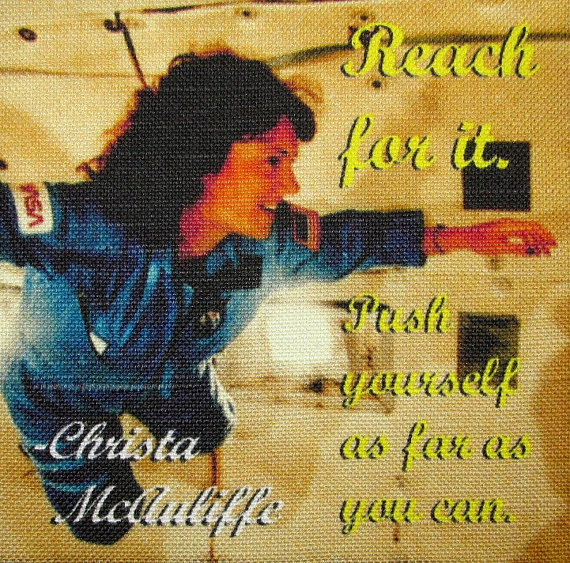
“I touch the future…. I teach.” – Christa McAuliffe

I remember my first years of teaching.   What an absolute joy it was… arriving at school at 6:00 a.m. and staying until 6:00 p.m., and my weekly routine of driving to school on Saturdays.   Teaching was my soul and my students became part of my heart.  I gave of my time by choice because I loved making a difference in children’s lives.

Teaching was fun.

Teaching was creative.

It was inspirational to innovate and design lessons that engaged my students and ignited their love of learning.

Teaching truly was a science and an art.  I still believe it is today… IF teachers are given the time and allowed to do what they are trained to do…

Today, teachers put in long hours because they have to…. and the extra hours are often not spent creating inspirational lessons… rather teachers are shackled with; endless paper work, constant tests to score and log and evaluate, countless meetings, tracking themselves on teacher evaluation sheets to prove themselves, attending professional development on yet another new program they are required to implement, reading the scripted programs handed to them to be followed and ready for the next day…

Christa McAuliffe was trusted as an educator, and given the liberty to be an innovative and inspirational teacher. 

Today marks the anniversary of the tragedy of the Space Shuttle. January 28, 1986 the shuttle exploded. I was in my dorm room at the University of Washington. It was one of those moments the heart skips a beat and one’s eyes become glued to the screen. No! It couldn’t be.

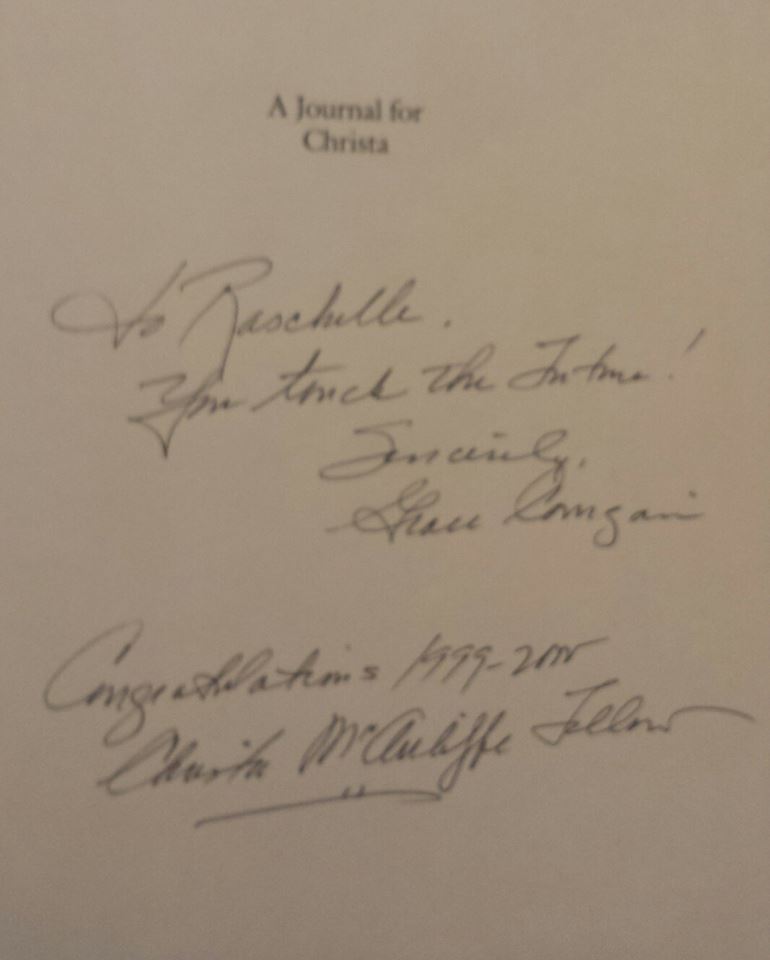
On that particular day, I didn’t know very much about Christa McAuliffe. However, 14 years later I was shaking her mother’s hand in Washington D.C. She spoke kindly to me and thanked me for my years of teaching. Grace George Corrigan smiled as she autographed the book she wrote in honor of her daughter, A Journal For Christa. I remember the awe I felt, listening to her speak of the memories of this special mom, wife, educator, astronaut… the goose bumps peppering my skin.  Christa, indeed, was one of those rare gems many aspire to be like.  She left a legacy.

Christa Book Cover  Christa Autograph

Christa McAuliffe was a teacher. An innovative teacher.   She was known as the “Queen of Field Trips” and she believed strongly in experienced based education. Her students conducted mock trials to learn more about the law. She developed a class on the role of women in the history of the United States. At first, she encountered trouble getting her course accepted, but she wouldn’t give up. Eventually it was placed as an elective and her students were inspired. One of Christa’s students wrote, “Mrs. McAuliffe’s course on the American woman changed my outlook on life. It was like she discovered something new every day, and she was so excited about it that it got the rest of us excited, too.”

A Message to Teachers Today:

I am in awe of the majority of teachers.   The challenges we face on some days feel insurmountable. We climb the mountain anyway.   Children come to us from all walks of life. We embrace them anyway. We are handed programs our expertise may not resonate with. We breathe life into them and navigate through them anyway. The powers that be want to judge us. We inspire anyway.   Christa McAuliffe Reach

Continue the path and the course in which learning is evident and alive.

Be innovative.

Creative.

Diverse.

Imaginative.

CONTINUE TO DO WHAT IS RIGHT FOR KIDS. Trust yourself. Surround yourself with your colleagues and inspire one another. Think outside the box. Be different. There is nothing common about you… nor is there anything common about any one of your students.

Motivate.

Inspire.

 “To (All Teachers), You touch the future!” Sincerely, Grace Corrigan

I dedicate the following video to each and every teacher across the United States. If you feel a need for a little inspiration right now, be touched by listening to this TED Talk video. Ken Robinson is an amazing speaker and will make you laugh. He may also give you pause about the current education reform efforts, and whether these efforts are the right direction for the future of our children.

The summary of Ken’s three principles in his TED Talk entitled: How to Escape Education’s Death Valley

  • Human beings are naturally DIFFERENT and DIVERSE.
  • If you can light the spark of curiosity in a child, they will learn without any further assistance…. CURIOSITY is the engine of achievement.
  • Human life is inherently creative.   One of the roles of education is to awaken and develop these powers of CREATIVITY.

 “Teachers are the lifeblood of schools.” 

 I encourage all teachers to avoid the culture of compliance. Be your unique self and encourage your students to be their unique selves.  I believe Christa McAuliffe embraced these same principles. If she were here today, I am certain she would be standing tall… encouraging us all to teach innovatively… and to infuse every lesson with diversity, curiosity, and creativity.

 I hold the torch for this kind of teaching. The fire burns fiercely. Will you join me in holding this torch?

25 Things you may not know about Christa linked here.

Christa McAuliffe 4 (2)

“I touch the future…I teach.” Christa McAuliffe

Fire is Catching

RAZ

A Mommy, Wife, Educator… Opposed to all things COMMON.

ALL Babies Walking By Six Months Old… A Satire on the Common Core Charade.

“A Lie cannot live.” – Dr. Martin Luther King

Omission 2

Race To The Stadium (RTTS) established

A group of professional sports team owners and product sponsors decided the United States was losing ground globally in producing high quality athletes…. so they met with The President and the National Secretary of the Department of Sports to convince them to set new athletic policies. Soon after, the new RTTS (Race To The Stadium) was established.   A committee was selected to write new and rigorous standards starting from womb to stadium.

A handpicked group of professional team owners and employees of national product sponsors were selected to establish the new standards. A few adult level doctors were also added. Written in under a year, they were rolled out to the state Governors and the State Superintendents of Department of Sports. In order for the new Common Sport State Standards (CSSS) to be adopted, only the Governor and State Superintendent needed to sign.

Two signatures.

Bam!

It was then pushed through the State House of Representatives and the State Senate with little time for review or public input. In fact, these standards were pushed upon the states by the federal government and the National Department of Sports. This was not initiated by the people or for the people….

“Government of the people, by the people, for the people, shall not perish from the Earth.”   Abraham Lincoln

Putting the values of the United States Republic aside, if the two governing officials signed the CSSS into law, a stimulus package of money arrived from the federal government to implement the new standards. If not signed, money was denied and/or removed.   “Naughty” were the states who did not sign on.

Naughty, Naughty. “You will leave your babies behind.”

Some Governors later admitted they were asked to sign the document before the final draft of the standards was completed, but… I guess this is beside the point.

The State Superintendent also needed to sign the document. No committees formed. No review process. No early childhood physical therapists consulted. No pediatricians consulted. No athletes gave input.

Definitely no parents. “What do they know?

About a year after the State Superintendent signed the standards into law, a soft roll out to parents and pediatrician offices was initiated so enough time would be given to prepare their homes and offices. New baby materials, sports products, and technical support would need to be purchased to assist in helping the babies achieve the new standards.

Here were the new early babyhood Common Sports State Standards (CSSS):

  1. All children shall walk by 6 months old.
  2. All children shall run by 6.5 months old.
  3. All children shall do summersaults by 7 months old.
  4. All children shall do cartwheels by 7.5 months old.

It was ensured, by adhering to these rigorous standards, ALL babies would be on track for the Olympics and/or professional athleticism. No one questioned the age appropriate sports standards. No one questioned who wrote the standards… and those who did, in any way, were looked down upon.   Many, at first, even believed these standards were appropriate, necessary, and the answer to preparing the babies for a solid future in professional athletics and quite possibly a turn in the Olympic Games.

In the beginning, very few realized the standards were written by the owners of handpicked professional teams and the high ranking employees of the favored brand name sports products… like… hmmmmm….Nike, Gatorade, 5 Hour Energy… these well intended people, of course, really desired to start our babies off on the right foot. (No pun intended).

Next, a nationwide curriculum, specifically designed for parent use, was written by the same people… contracts were drawn up, with undisclosed amounts of money to be paid to them. This curriculum was accessible to parents once they bought a tablet. This tablet was the only platform that could run the software. If they followed the steps perfectly, the parents were promised their children would accomplish these high and rigorous goals.

Interested in following the money?:  Ten Common Core Promoters Laughing All The Way To The Bank.Money eye

Parents followed the lock step programs, using the accepted products only,  and pediatricians tracked their patient’s progress and entered weekly progress into a data tracking system to help parents target certain muscle groups that were failing in their babies legs.

Gill Bates, of course, in all of his athletic background and expertise, paid $200,000,000 to the committee to write the standards. The standards started at one day old. Each day, starting at day one, a lock step, scripted walking curriculum was established…incorporating all the sports baby products sold by the very writers of the CSSS.

Next, knowing the standards needed to be embraced and accepted by the masses, Bates, the athletic expert, also paid at least $200,000,000 for the promotion and advertisement of these new and rigorous baby standards… AND… do not forget… he also funded, through grants, the development of the software for the tablets for parental use.   Just imagine the profits $$$$$ made after every parent purchased one of these tablets.

Interestingly, even Gill Bates admitted the success of the new CSSS wouldn’t be known for 10 years. Listen at 45:22 in his speech at Harvard, “It will take 10 years to know if this “sport” stuff will work.”   Watch it (here).

The signs of implementation were clearly seen, as anyone driving through the majority of communities across the nation, or observing activity in local parks, saw no children playing or mommy’s pushing babies in strollers. Most were home practicing and following the programed script to ensure their child was walking on time. They didn’t want to “leave their babies behind” or to the doom of factory work for Nike.  Rather their dream was for their child to have the best chance of wearing the Nike gear out on the court as an athlete.

With time, many parents became frustrated with the script, and called their pediatrician’s office with their complaints. “This isn’t working.” Or “Johnny isn’t responding to lesson 6.” Or “My baby failed the three month module test, what do I do next?” Having the pressure themselves to ensure all their patients walked on their 6 month Birthday, the pediatricians continued to encourage integrity to the national walking program.

The pressure mounted.

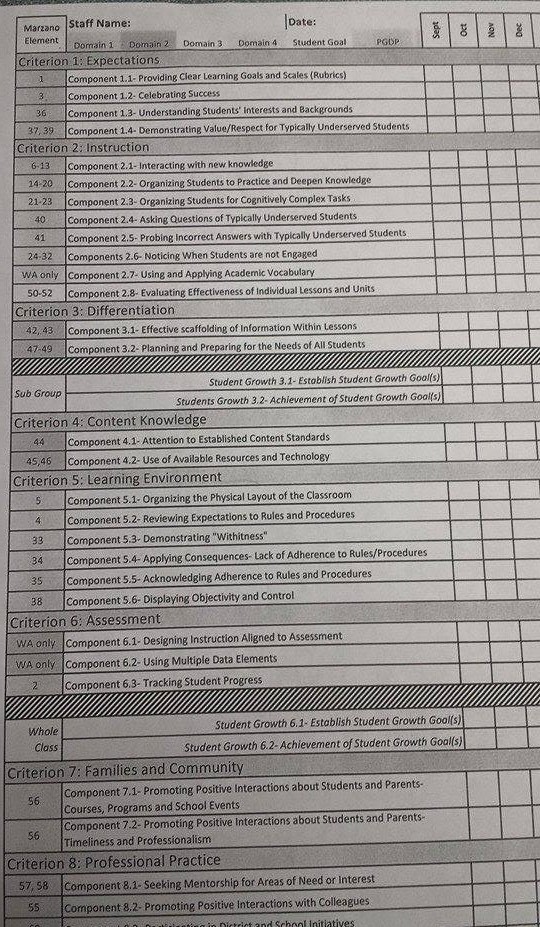
Each parent knew they were required to take their child to a Smarter Balanced Athletic Testing Center to be analyzed by their Certified Pediatrician. The Pediatricians had checklists full of Criterion, Domains, Components, and Elements… with detailed rubrics (oops, I mean scales) to be tracked. All total there were 41 Elements within the Domains through the Elements based on the Components they would be judged upon whether they met the Criterion. The parent was given an evaluation based on all of this. Within the first 6 months of the baby’s life, the parent had four formal observations to determine if they were accomplishing the 41 Elements within the Domains through the Elements based on the Components and whether they were on track to meet the Criterion.

It was all a little confusing.

Confused BabyThe parents were informed, by Senate Bill 5946, if their child was not walking by the exact date of 6 months old, they would lose their child for 3 hours a day to a state run walking school with the goal of closing the walking gap. Soon there were walking schools springing up throughout the land, filled with state trained certified walking specialists holding the “key” to successful walking.

In a private meeting, the Smarter Balanced Athletic Consortium (SBAC) met, to establish what level of walking would be acceptable to pass the 6 month walking mark.  They based the cut scores on the previous year’s field test done on countless babies throughout the land. The cut score was publicized and revealed approximately 30% of the children would indeed be able to walk by the 6 month mark. However, 70% would fail.

The parent’s fears grew.   They wanted the best for their babies, and not passing the Smarter Balanced Athletic Test would doom their babies to a life slaving in the Nike and Gatorade Factories, or worse yet, peddling 5 Hour Energy Drinks in local stores.

The state run walking schools were prepared, however, and remedial walking programs were written and sold to these schools by the very same company who designed the Smarter Balanced Athletic Test.

The Pressure Mounted.

District Doctor’s Offices, overseeing the Pediatricians, hired testing coordinators. The coordinators found practice walking interim assessments with checkpoint assessments in between the practice interim assessments. Parents could administer these practice tests in their own homes to prepare for the ultimate Smarter Balanced Athletic Test. The data was uploaded to the District Doctor’s Offices in order to follow each baby, parent, and pediatrician and keep track of who was performing well.

Next, Walking Specialists were hired to assist parents in how to implement the tablet run Walking Program and answer the questions that continued to arise. The Walking Specialists were also able to help the parents look at the data from the interim tests and the checkpoints in between the interim tests. This assisted the parents to better understand how to target specific muscle areas needing stimulation, and established next steps for their baby in order to ensure their success on the Smarter Balanced Athletic Test.

The end goal for all, no matter what level they served in the Sporting System, was to get the baby to….

Pass.   The.   TEST.

The Pressure Escalated.

As the parents implemented the new Walking Program, they were informed and mandated to attend several evening professional development classes in order for them to understand the new Parental Evaluation System. You know, the one in which they had to show evidence of the 41 Elements within the Domains through the Elements based on the Components to see whether they were on track to meet the Criterion?

Baby said, “Eh?”

Their checklists looked much like the following:  TPEP List 3

Harder still, the parents had been mandated by the state to utilize a new Nutritional Program and Eating Schedule, (written by 5 Hour Energy), for their babies that was entirely different than the one used before. So… now… they were implementing the new Walking Program which included utilizing a new technology with the tablets, establishing a new Nutritional Program and Eating Schedule for their babies (thanks 5 Hour Energy!), as well as learning how they would be evaluated upon these things… all at the same time.

Sheesh!

Who would have dared question this charade?

 It was a Race To The Stadium…

 The Pressure Continued to Mount.

The Pediatricians were “under the gun” too. They were also judged and evaluated by similar criterion, much like the parents. Percentages of pass rates of his/her patients were logged and tracked into CEDARS, the state data bank. The data was then uploaded to The Feds. FERPA laws were loosened, so data could be released to third party vendors. Every pediatrician… every parent… every baby followed…

Data Tracking of Children.....Tracked.
Data logged.
National Baby IDs established.
The following link shows how to access the National IDs and how the FERPA laws have been loosened.  Click (here).

If the Pediatrician’s percentage rate was found failing, the state closed the doctor’s practice, and brought in their own set of better trained, “higher quality” doctors to run the offices.  All at tax payer expense of course.

Sadly, the pediatricians were tied to their desks, entering their evaluation data into computers from the four observations of each parent capturing the 41 Elements within the Domains through the Elements based on the Components to see whether they were on track to meet the Criterion.

Baby said, “Eh?”

The actual time with their patients decreased significantly because most had anywhere from 45 – 100 parents to track times four in a sixth month period.  (There’s some mathematics for you!)

Note… this was a “growth model” with the full purpose of helping the parents become better at teaching their babies to walk.

Again Gill Bates got involved, and helped fund Pediatrician For America (PFA). This program allowed those with a bachelor degree to be put in five week crash courses to become Pediatricians. After all, most were young and willing to follow the script and do exactly what they were told. Another benefit to the PFA, was the lower end salaries paid to these new doctors due to their placement on the salary schedule.  Additionally, this was considered a good thing because many of the traditionally educated Pediatricians were leaving the field and Pediatrician shortages became a real problem.

Sadly, the PFA program began to collapse too, as most PFA doctors gave only two years of their lives to helping babies walk before moving on to other jobs that became their real careers.

The Pressure Increased.

In the beginning stages of the implementation of the CSSS (Common Sports State Standards), it was decided the parents needed to incorporate a new sleep therapy program. New “research” had come out stating babies with strict sleep schedules were better able to practice their leg exercises each day to prepare for walking. The parents again, were called to more professional development in the evening to understand the strict sleeping program and how to adhere to it without waiver. Boxes arrived to their homes.   They cleared out hall closets to make room for all the resources arriving from the state.

The Pressure Point of Collapse Loomed.

A few parents and a few pediatricians started to raise some questions. They were scorned. Didn’t they understand these national Common Sport State Standards were written by experts in the field and necessary to prepare babies for the Olympics and Professional Sports? Didn’t they understand how critical it was to be able to compete globally with other countries producing star athletes?

The few parents and pediatricians grew in strength. They began to uncover the CSSS weren’t written by experts, but rather by the owners of professional sports teams and the product sponsors. Their voices grew.

In fact, in New York State alone, the Pediatricians wrote a letter of concern regarding the evaluation of parents by baby walking scores. It was signed by more than 1,535 New York pediatricians and more than 6,500 parents: Following The Common Core Money.  Where are Millions of Dollars Going?

Another joint document was written and signed by over 500 early baby specialists stating their concerns with the CSSS: (Joint Statement).

Still many states insisted on staying the course. Eyes shut. Ears closed.   A lot of officials made arguments the cost was already too high and there would be no way to abandon the CSSS.

Dr. Peg Luksik wrote, “When parents approach school districts or state legislatures with their concerns about the disasters occurring in Common Sport “homes” and ask that the program be stopped before even more damage is done to the education and self-esteem of America’s little ones, they are told that such a step would be irresponsible because of the huge amounts of money that have already been spent. So our “babies” will just have to “soldier on”.

Dr. Luksik went on to say:

The apparent success of that argument must have many other industries rethinking their approaches to problems.

Pharmaceutical companies who have been forced to stop production of a new drug that made it all the way to the final testing stage before the discovery of serious negative side effects could claim that they had already invested a great deal of money, so it would be “irresponsible” to stop production at this late date.

And companies that brought drugs into the marketplace, only to be faced with recall either because the drug had not been properly tested or unforeseen complications had arisen from its use, could make the same claim and avoid having to pull that product off the shelves.”

 Dr. Luksik makes more arguments for the halt of the CSSS despite the money spent so far.  She furthered her logical argument by mentioning how the auto industry may need to rethink how they go about business.  Baby Driving 2

A failing car?

No need for recalls.

After all… it cost too much to design the car, manufacture the car, and transport them to all the car dealerships.

Her full article can be found (here).


Fast forward ten years.

“Funny” thing…

Few pediatrician doctor’s offices exist. There are thousands and thousands of state run baby schools of walking. Parents are up in arms… protesting. Their babies no longer theirs.

And…

“Funny” thing…

Ten years later… The majority of 6 month old babies… stillaren’twalking.

Ingenious Experiment.

For Whom?
FOR WHOM?
Real or not real?Peeta Mellark, The Hunger Games

This is the birth to kindergarten mental health interventions for babies. This is “research” for the early learning and the $1 billion Obama is funding for daycare and preschool.  See for yourself: Obama Targets Babies

Martin Luther King Graphic

Passionately Submitted,

RAZ ON FIRE

References:

  1. HB 5946: http://app.leg.wa.gov/billinfo/summary.aspx?bill=5946&year=2013
  2. Teacher Evaluation Bill:  http://tpep-wa.org/about-tpep/legislation/essb-5895/


Common Core and Testing Concerns… A Letter to My Principal

Background Context about My Letter

Before reading my letter to my principal I want it to be public knowledge that I adore and love her.   She is an amazing administrator on so many levels.   In my 25 year educational career, I have encountered two principals I hold in the same high level of regard…  two principals that fall into the category of Distinguished. My current principal is one of those two.   The most critical practice she employees is listening.  

I have the opportunity to express myself.

I have the opportunity to share my perspective.

I have the opportunity to disagree with educational policies.

I have the opportunity to share research I encounter and we actually talk about it.

I have the opportunity to question decisions and seek understanding.

I have the opportunity to ask the tough questions.

She listens.

She honors my expertise and what I have to contribute to my school’s community.

She shares her perspective, too, and I listen.

Sometimes she challenges my thinking.

I feel respected.

I feel honored.

Principals are being put under the same pressures as us teachers.   They, too, are being handcuffed with educational mandates and policies that are shackling them to their desks, writing endless reports on every teacher to the nth degree of minutia.   (This is not an exaggeration).

I met with my principal this Friday, January 9th, 2014, and was able to discuss many of the topics I’ve included in this letter.   My purpose for writing this letter is threefold:

  • I wanted her to have the links to the videos and articles I was referring to so she could get some context around what I was sharing.
  • I wanted to have a letter written for other educators that may act as a template or a talking point to open conversations with their administrators.
  • I could utilize talking points in this letter to use in my future letters to our Governor, our State Superintendent, and our legislators.

I am sure my principal and I will have many, many more conversations around the topics in this letter. The key is… I can have these conversations. I am not shot down.   She doesn’t look at me like I am an alien from outer space.   She values me as an intelligent human being whom has the best interest of every child and teacher in my school at the center of my heart and mind. She understands these conversations are necessary if we truly are going to improve our schools and advocate for what is the very best for our children.  In my opinion, my principal has the same heart as Carol Burris.

Carol Burris, New York Principal of the Year 2013

Principal

I continue to receive letters, email, and instant messages from teachers sharing their stories.   I am also getting letters, emails, and instant messages from parents sharing their stories.   I plan to continue to write and advocate and use these stories to try to help stop harmful mandates and policies.  My dream is for teachers to thrive and be freed from their handcuffs so they have the time to fill their days with creative and innovative instruction without the pressure of test after test after test.

For those reading my writing for the first time, I hope a few things can be understood:

  • In the beginning I accepted the CCSS standards and did not ask a whole lot of questions. Questions like:  Who wrote them?  What was the process? Who reviewed them? Who approved them? This is true of many educators across the nation.   However, as knowledge came my way, and I was willing to dig underneath the surface and start asking questions… I have come to be opposed to the CCSS standards at the early childhood level for many, many layered reasons.
  • I do believe in standards. They act as guides for teachers. However, the standards need to be developmentally appropriate and never used in a punitive nature to children or teachers or schools.


Good Morning Principal,

It is Saturday morning and I wanted to send you some of the things I have been reading and researching to establish a deeper understanding as to why I have become so burdened for our children, our teachers, and our schools.  The first video link is the best one I have seen yet around why the early common core standards are not developmentally appropriate.

Dr. Megan Koschnick says, “Children cannot yet think abstractly until the Formal Operational stage occurring around 11 – 15 years old.”

She went on to say, “Children will be measured against inappropriate standards and will be held back and tracked into remedial classes that they don’t really need.”  (HB 5946 in Washington State for example)

Dr. Koschnick speaks here:  https://www.youtube.com/watch?v=7tSQlJE6VuA

This second video is by Dr. Sandra Stotsky, one of the 30 people invited to be a part of the validation committee of the Common Core.   She is one of the five that would NOT validate the Common Core.  She explains very clearly why she would not validate the CCSS and in her ELA expertise why the push for text younger and younger is not appropriate, and she also addresses a child’s natural process for writing.

It is interesting to note her comment about how the five people who would not validate the standards simply disappeared off the committee.   The document only lists the 25 that did validate the CCSS. Why not be open and honest to the public and list the five people who would not validate the CCSS?

Dr. Stotsky speaks here: https://www.youtube.com/watch?v=z0aLonR51Ac&app=desktop

My main questions and concerns around CCSS is knowing that none of the writers were early childhood specialists, none had any real classroom experience, three of them a few years at secondary, and most worked for educational businesses and the testing industry.   One of the lead math writers works for Pearson.   Pearson is now the writer and publisher of PARCC, SAT, GED, and many more tests. (McGraw-Hill publishes SBAC).   They also have their fair share of the textbook industry, including all the remediation tests and programs.   Is it ironic they write a test, set the cut scores at 70% failure, and then are able to sell the remediation programs?

Here are some links about Pearson and the monopoly they seem to have in the United States education system:

  1. http://www.alternet.org/education/corporations-profit-standardized-tests
  1. http://www.huffingtonpost.com/alan-singer/enough-is-enough-pearson-_b_3146434.html
  1. http://dianeravitch.net/2014/12/31/shocker-after-pearson-aligns-ged-with-common-core-passing-rates-collapse/

Pearson $

From the Trenches:

As educators, many things come our way and most of us do not question anything.   In fact, it is discouraged.   We are expected to take our marching orders without question.   Courageous conversations around what is best for kids are not had.  There isn’t time.   I often feel we chase our tails and jump from one thing to the other without really taking the time to examine, critique, ask critical questions.  We panic, we try this, we try that… etc…  At year 25 in my career, and in my past being recognized with several awards for my innovative teaching and motivation of children, I have never seen anything like what is happening now in our schools across the nation.

Obviously I am very, very concerned.  I have also done some research around Amplify and have found some interesting information.   Amplify is owned by Rupert Murdoch.  He is the big Fox News multi-millionaire.  He also has purchased Core Knowledge which two of our schools are using.   He is quoted as saying, “The United States education system is worth 500 billion in untapped profits.”

500 billion.

Rupert Murdoch started a company called inBloom.   Bill Gates funded the development of the software of inBloom.   InBloom is a testing and data tracking system for use in schools to see children’s growth over time.   Ten states were using this at one time.   It slowly collapsed.   Louisiana and New York were the last to hang on to this system.   Data was leaked to third party vendors and parents became outraged.  Due to this “leak”, inBloom closed its doors and failed as a company.   Well, Rupert Murdoch isn’t so stupid.  He regrouped this company, and it has now resurfaced.   Its new name… drum roll please…

Amplify.

He hired Joel Klein, the ex-chancellor of New York, to be his CEO. The following is an article about how they are trying to keep Rupert Murdoch separate from his new company because of the history of the failure of inBloom:

Amplify Education Tries to Build an Identity Outside of New’s Corps Shadow:

http://www.buzzfeed.com/mollyhensleyclancy/amplify-education-tries-to-build-an-identity-outside-of-news?utm_term=.eiDDP5N26#.faA9KGWdw

I have other links following the history of inBloom and its evolution to Amplify.

Therefore, this is why I have growing concerns as to many, many decisions that seem to be made without a full comprehensive review.   Somewhere decisions are made with no real trial period with lengthy discussions to follow, from the field, in order to make informed decisions to purchase a testing product or any other product for that matter.   It seems, in order to evaluate a new product, a few schools use the product and then there should be a discussion around the pros and cons of its effectiveness? A courageous conversation or two or three occurs before purchase? No?

I shared a little of this with a few coaches and they looked at each other, smirked, looked back at me and said, “So, what are your first steps as a data coach?” There are literally no opportunities to discuss multiple perspectives and the impacts we are seeing within the walls of our schools.   My questions were completely discounted and ignored. I had expressed my concerns around the test questions for both Amplify and the SBAC.   The high level of reasoning expected of the children is truly astronomical. I shared how we all read the book a few years back, “How the Brain Learns Mathematics” By David Sousa, and tried to put on the table how it said children’s ability to reason does not occur until 11-12 years old. I innocently asked, “Are you at all concerned, too? Is it concerning at all that the cut scores are set at 70% not meeting the standard?”   And this is the moment I got the “look” and the question about my first steps in my new job. In other words, “We will not discuss this with you.”

It seems we must assimilate much like The Borg in the T.V. series Star Trek.   Even John Luke Picard assimilated into the Borg until he was rescued and disconnected.

The Borg

My parent hat:

As a parent, I am not willing to sacrifice my child’s childhood, his chance to explore, ask questions, use his imagination, create, innovate, discover, play… I believed my job as an early childhood educator is to foster the curiosity of my students.  Students that are curious will learn.  Especially at 3 to 12 years old.  Make a learning environment that looks like a living, breathing museum fosters children’s desire to… race for books and to read and research,  perform science labs, work hard on math skills, and so much more.  When I had my own classroom…  well planned, creative, innovative, and integrated learning… had my student’s achievement soaring through the roof.  (You can read more here.)

My Educator Hat:

I strongly believe we are handcuffing teachers with compartmentalized programs that are killing the life blood of what makes teaching teaching and learning learning.   We are piling things on their laps that their legs can no longer hold, and they become lemmings… (term used by kindergarten teacher) marching in line, doing what they are supposed to do… all the while heading for a cliff.

My worry, in this Race To The Top (RTTT), is we are, at a more rapid speed than I realized, becoming Test Prep Factories.   Our classrooms are being filled with instruction that can only be measured by a test item and the policy makers are forgetting the most critical components of learning in early childhood children.

RTTT or Real Learning

Here’s China, who many seem to point to as the “ideal” and state, “We need to ‘catch up’.”   I have heard often we are “competing” with China.   It is interesting for me to read the real story behind the red curtain. As a parent and educator, I’m in no way interested in an educational system that produces regurgitating robots.

Inside a Chinese Test Prep Factory: http://www.nytimes.com/2015/01/04/magazine/inside-a-chinese-test-prep-factory.html?_r=2

And for a little more “fun”… I found this article to be telling… and I love everything this man writes.  “Your five year old failed a standardized test. Therefore he is Stupid, Insane, and Doomed to a Life of Failure”:

http://themattwalshblog.com/2014/02/10/your-5-year-old-failed-a-standardized-test-therefore-he-is-stupid-insane-and-doomed-to-a-life-of-failure/

The above is not far from the truth.   In California they are now experimenting with a 3 year old Common Core Test.  A research project is studying whether they can look at predictors of math failure based on 3 year old responses.   To me, this is nuts.

So… on this Saturday morning… I decided to pour my heart out… and give you some context to where my concerns are in regards to how children learn and the over testing.   Teachers are being held to these standards (many that are being shown to be developmentally inappropriate in the name of “rigor”), yet are stolen days and days and days and days and days of instruction time for more and more and more and more and more….

TESTS.

A pig does not get fatter by weighing it.   It needs to be fed.

Sad Pig

If children do not receive appropriate instruction, then how, dare I ask, are these teachers expected to get their students to standard?

I really hope, the powers that be, start examining the reality of the teachers in the trenches…

How Principals can Avoid Administrator-itis:

http://www.washingtonpost.com/blogs/answer-sheet/wp/2014/11/24/how-teachers-can-avoid-administrator-itis/

I wish this article was entitled, how District Offices and State Departments of Education can avoid administrator-itis. It seems the farther removed an educator becomes from a classroom, the more they forget how the decisions they are making often place many burdens on teachers laps, sometimes to the breaking point.   This is one of those times.   When I was the K-12th grade district math coordinator in my last school district, I always viewed everything through the eyes of the teacher.   I led a Math Cadre of teachers, who met monthly to guide the decision making around mathematics instruction. Teachers had real ownership of the full process.

Our schools and teachers are being zapped with endless tasks and expectations that I believe will not get us where we want to go with our children…  there are more important things about the life of a child than what can be measured by a test.

Here is an example of something I wrote the other night as I reminisced about inspirational teaching and learning:

A Lesson in Science and Integrated Learning

My son got a snowman kit in his stocking.   After building the snowman, we watched it slowly melt.

I asked, “Is this a solid or liquid?”

Snowman Melting

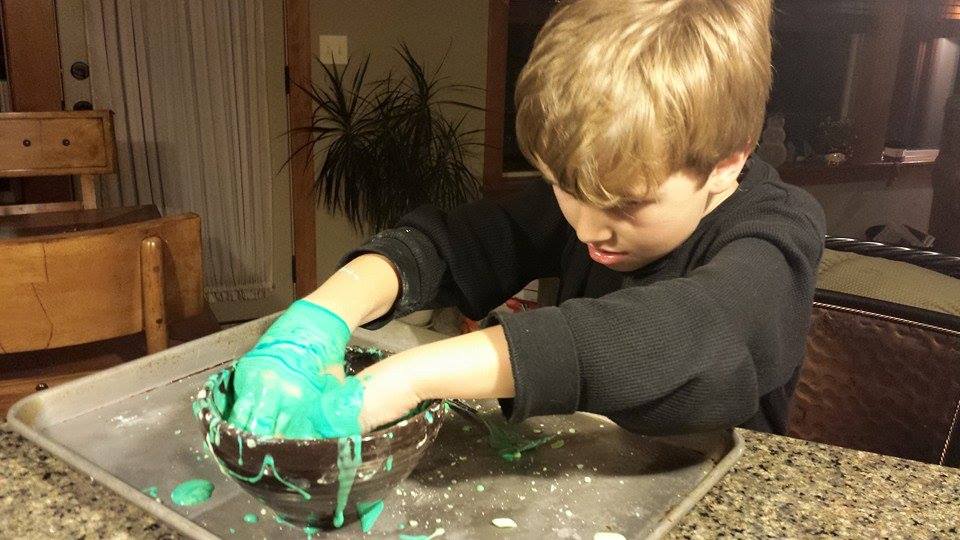
As we discussed this idea I went to my cupboard to find the ingredients for making Oobleck. My son and I googled the Dr. Seuss Book and read the story… and made the substance… Many teachers do this every year.

Oobleck #1Oobleck #2

When I taught I was able to take the idea of “Oobleck” and turn it into a full scale integrated unit of study.

With 5th Graders I used to have the substance premade. I made enough for each group of four kiddos, but it was dyed blue. I informed them I had written a NASA Astronaut and they sent me some samples from the surface of Neptune they were able to obtain. I shared the scientists from NASA were requesting for students to explore the properties of the substance and to send them our findings.

My first question I wrote on the board was, “Is this a solid or liquid?”

Students were given a piece of paper and divided it in half. They labeled one side “solid”, the other side “liquid”. They were to experiment with the substance from Neptune and discuss the properties of each and write observations on both sides.  Later, students wrote detailed descriptions and included this in letters capturing their findings.  A month later, a return letter came back with gratitude for their hard work and thorough reports. (Written secretly by me of course!)

Next I posed a question… what is really known about the planet Neptune? Books were checked out and computers were used to research. Interest grew and students began doing studies of the other planets.  They wrote reports.  We learned about topic sentences, detail sentences, conclusion sentences, and paragraphs.

They began to make charts and graphs with the sizes of the planets including measurements like diameter and circumference as well as surface area. This became a great lesson in place value in a meaningful context. Distances from the sun were explored, and large numbers were written on charts and graphs.

Student’s natural curiosity led to a lot of research, reading, science, and math. The unit always ended with each student writing a story of an expedition to another planet. Within their story they had to include at least five facts of the planet they explored.

Creative and Expository writing continuous… it was a natural part of our day, every day, writing for varying purposes.

And…  my students loved to write.  Surprised?

What standards were taught? What learning measurable?

Most students scored a “4” for their love of learning as well as a “4” for their incredible imaginations… Of course, I collected their papers and used rubrics to score their writing and gave the students constructive feedback. My point here is, not every iota of learning can be measured. In fact, dare I propose… the most important kind of learning can’t be measured by a test question?

Matt Damon 2

Teachers need the time to plan lessons like the above.   Teachers are creative human beings trained to do this.  I am saddened by the programs handed to them that squelches opportunities to innovate, create, and inspire.

One teacher from another school district contacted me and said, “My principal came to my room today and told me to stop being so creative.  There isn’t any time for creativity anymore.  Please stick to the programs given to you. It is critical these students pass the test.”

Sad.

Disheartening.

Thank you for hearing me out, principal.   In my twenty-five year career, you are one of two principals I have worked for I believe understands the full range of instruction, and if you don’t, you ask for guidance.  I am thankful you have not fallen into administrator-itis…  I appreciate your willingness to listen, hear multiple perspectives, and have courageous dialogue around educational issues.   I am asking a lot of tough questions right now.  In my past school district, I knew each of the school board members personally and had a strong, working relationship with the superintendent.   I often met with them and spoke at school board meetings.   I am just a little fish here in Spokane.   It is the conviction of my heart, and what I am seeing inside the walls of schools, and the exhaustion on teacher’s faces, that is compelling me to write this lengthy letter to you.

Sincerely,

Raz

(RAZ ON FIRE)

DivineSpark

Fire is Catching

A Common Core Grinch at Christmas… Part Two… Remembering The Snowflakes

Children are like snowflakes, no two are alike.

I think about the first snowy night of each winter season and picture myself outside with my face to the sky. It’s peaceful. Quiet. Each flake lands softly on my cheeks… nose… brows…   As I spread my gloved hands outward, a few flakes land and find a safe harbor for only a few twinklings before melting. Lifting my finger to take a closer look at each, I smile.   There is something magical in this moment knowing I’m looking at a unique and beautiful creation of nature. If I was given a microscope, I know its magnificence would be amplified into its individual glory.

Our children are like snowflakes.

Glorious.

They grace our lives, but for a moment. As a parent, they pass through our lives leaving distinctive imprints upon our hearts and minds. As teachers they honor us with their enthusiasm and passion. Their individuality is a precious gift. Being a part of their lives for such a brief flash is not only an honor, but the greatest blessing life has to offer.

Our children…

Snowflakes.

This doesn’t sound very Grinchy does it?

On December 18th I revealed I became a Common Core Grinch. You can find Part One here. As I have personally watched the unraveling of the Common Core Reform and witnessed its talons reaching into our states, school districts, schools, and classrooms my heart has grown sick with the results. The impact it is having creates boxed in uniformity for the teacher and very little room for the individuality of a child. From my perspective, Common Core is analogous to a blow torch.   It is melting, at a faster rate than can be grasped, our precious snowflakes.

I’d like to suggest that our teachers are like snowflakes too. Each one I have met and worked alongside has had something inimitable to impart to their students.   Teachers are individuals too. I wonder sometimes if it is the goal to be able to walk down the hallways of our schools and see cookie cutter teachers on the same exact page, teaching the same exact lesson, from the same exact unit, in the same exact way, using the same exact words…?

Not if you’re a snowflake.

This is education? This is our ingenious plan for getting every child to the same exact standard, on the same exact day, in the same exact moment… so what? … So each child can take the same exact test, on the same exact day, so we can measure how “same exact” they are? And… if they perform well, it is THE measure by which we say they are college and career ready?

Not if you’re a snowflake.

The Common Core Standards are definitely here.   The following are a few links to show where each state stands now with the Common Core:

http://truthinamericaneducation.com/common-core-assessments/what-states-have-pulled-out-of-their-common-core-assessment-consortium/

and…

https://deutsch29.wordpress.com/2014/07/21/a-july-21-2014-update-on-common-core-parcc-and-smarter-balanced/

Despite what the advocates are saying about…

*how they are only a set of standards and…

*how school districts have the choice of resources and programs and…

*how they are the roadmap to college and career…

                                                                  … I have come to learn just the opposite. 

The Common Core Standards were written between 2009/2010.   Superintendent Dorn formally adopted the Common Core Standards on July 20, 2011 in Washington State. Most of the public did not begin to even hear about the standards until the Fall of 2012.   One would think there would have been various open forums and an invitation to review the standards by educators at all levels as well as any and all parents….?   It makes me incredibly curious as to why, from the onset, this major overhaul was done in secret? What was there to hide, IF these standards were the best for our children?

I can no longer stick my head in the sand and pretend I’m an ostrich singing, “Everything is Awesome!” (https://www.youtube.com/watch?v=t6lHm-stXdM) “Everything is awesome when we stick together…. and we are all part of a team… we’re the same… I’m like you… you’re like me… we’re all working in harmony….”   Think of Emmet in the Lego Movie… Think of The Capitol in The Lego Movie… You, too, can be successful if you just follow the robotic, numbered steps… and you, too, will please The Capitol and Lord Business as long as you fit the mold.

Thank God for The Double Decker Couch. Yay Emmet! He had been brainwashed like the rest, a perfect male “Common” Citizen, but somewhere in the recesses of his mind… a creative spark existed.

I found the following 39 minute documentary to be helpful in understanding the “who” of Common Core:
BUILDING THE MACHINE:  https://www.youtube.com/watch?v=zjxBClx01jc
Both sides of this critical issue speak. It may cause a small tilt of the head and at least create some new questions to emerge. How many of us took the time to ask the bold questions when we first heard the term “Common Core”?

I know I didn’t.

I sat in a math meeting when I heard it for the first time. My first thought was, “You’ve got to be kidding me?   This is the fourth time the math standards have changed since 1997.” I returned to my building, innocently doing my best to implement the new standards. It wasn’t until the Spring of 2014, when I walked up and down the aisles of my school’s computer lab (set up in haste in the art room placing the art teacher on a cart) that a small little buzzer went off in my head. I watched 8-12 year olds struggle through the field test of SBAC and a small red flag took root in my brain.   Now the RED FLAG is waving boldly and asking the hard questions… Who wrote these standards?   Who reviewed the standards? How much is this costing the school system? Where is the money coming from? Who is paying for this? Who is profiting from this?

Follow the Money:

http://www.washingtonpost.com/blogs/answer-sheet/wp/2014/12/21/heres-who-got-the-biggest-gates-foundation-education-grants-for-2014/

http://truthinamericaneducation.com/common-core-state-standards/state-costs-for-adopting-and-implementing-the-common-core-state-standards/

http://www.alternet.org/education/corporations-profit-standardized-tests

I have come to believe, rather than snowflakes, we’ve been handed a cookie cutter recipe with cookie cutter programs which magically, if used with integrity, will create cookie cutter kids.   If we are good cookie cutter teachers, and follow the recipe to the “t”, then and only then, will our students successfully pass the SBAC test…. ? Hmmmmm…

Ironically, the cut scores are set for 70% to fail:

http://www.washingtonpost.com/blogs/answer-sheet/wp/2014/11/20/good-luck-understanding-how-they-will-score-the-common-core/

None of the above works if you’re a snowflake teaching snowflakes.

One 5th grade teacher put it this way, “I feel like I used to be an artist.   I used oil paints and was part of creating beautiful canvases full of unique pictures. The canvases varied in size and shape, and on each one I utilized a different set of colors. Now? I feel like I have been handed a black chalk board and a piece of white chalk… and I am asked to create miracles.”

This teacher has been recognized for her success in the classroom with over twenty years of teaching experience. She has committed herself to work in high poverty schools and has a track record of motivating her students and seeing them excel. She is a snowflake.

I encountered another snowflake amongst the growing number of educators raising the red flag.   Brandon Parsons, 7th Grade world history teacher from Ohio, posted, And the first-ever Roman Concrete lesson is done (got observed today, too). The kiddos learned how to mix and pour concrete, learned how the Romans came up with the idea originally, and also found out that their formula was actually stronger than our modern Portland cement! The first few periods’ batches of concrete turned out pretty good (already started to harden)! (and all of this done WITHOUT technology or computers, thank you very much!)”

Brandon Pic

Brandon Parsons is a snowflake. He had the courage to create a dynamic learning experience for his students on the day of his formal observation.

A few weeks ago I stood in the back of the room next to a kindergarten teacher.   Many amongst the staff refer to her as “The Child Whisperer”.   She leaned over and whispered in my ear, “All I feel like I have done so far this first trimester is test.  It has taken so much time away from the kind of teaching I used to be able to do on a daily basis.”

I sympathized, my Grinchhood surfacing and shaking its head at the effects of Common Core.

On Friday, the last day of school before the break, I encountered her with her students in the hallway. She tapped my shoulder and inquired, “Have you seen the Gingerbread Man?” I was confused at first until I looked at her line of students. The curiosity painted on their faces took my breath away. I am sure she drew them into the famous story and had baked a Gingerbread Man for them to eventually eat.   Do you think these students will want to read this story again? Do you think their minds were activated and loving learning?

“The Child Whisperer” is a snowflake.

Another snowflake, Lauralee Klingler, an incredible 3rd grade teacher has been an example to all of us. Her wisdom in regards to children has taught me so many things over the past eight years. Most recently she posted, “The Christmas Spirit came to my classroom today…One of my students heard that a student was going to have no Christmas. He brought to school today two boxes. One box full of used girls’ toys from his house and the other box full of used boys’ toys. He said, “Mrs. Klingler…I didn’t want the other students to feel bad if I just bring a toy for _______, so I brought one toy for each student.” He went around the classroom with a heart full of joy and carefully picked out one toy for each student. My students absolutely loved their used toy and began immediately playing with them. This student gave the best gift of all…one from a selfless and pure heart…This kind of love reminds me of what Christmas is all about.”

Lauralee's Christmas Spirit

I believe this 3rd grade boy will make a difference in this world. I believe this kind of character surpasses anything the SBAC test will measure come this March.   This child is a snowflake.

I’m a snowflake too.

This night of the Eve before Christmas, I find myself thankful for two former students who reminded me of the spirit of education. In my angst, an instant message appeared on my phone this past summer. The two former students found me on Facebook and took me back to the good ole’ days. Both are now 28 year old, lovely ladies with young children of their own.   It was timely as I had been growing more and more depressed with the direction of my job and finding the mandates placed upon me sapping me of everything I believed and embraced about how children learn. My ability to create, develop, innovate, and use my talents learned through college and graduate school, and 25 years of experience with children, seemed to not matter anymore.   What mattered is I followed the federal, state, and district mandates and fit into the “common” box of teaching so students could fit in the “common” box of learning.

My Christmas gift this year comes from the memories ignited as their words tumbled forth upon my screen. It brings joy to my heart to be reminded of the kind of teaching that inspires… the kind of teaching that lights fires… the kind of teaching that captures and celebrates everything one high stakes test will never unearth.

This Common Core Grinch remembers being a snowflake and teaching snowflakes.

What learning and experiences stuck for these two former 4th and 5th grade snowflakes? Just what did these two beautiful and unique, young ladies share with me?

They remembered the three months spent practicing for the multiple act play. They remember learning 14 songs and dances, reading related content continuously, designing the props from the mathematics learned within class, drawing scaled models, measuring, adding, subtracting, multiplying, and dividing. Designing the tickets, running the fund raisers and keeping ledgers of the profits (using decimals in context), sewing costumes, drawing and painting the set…. This led to three performances and the gym packed to capacity each time.  (A group of 5th graders, 11 year olds, pulled this off!)

Cast 1    Oz Cast 2

They remembered the winter we studied the Arctic Regions. The students studied the native people and the animals.   They made temperature charts and learned about weather… they explored ice cube melting rates and made graphs of the melting times… they found the area of the continent… and this sparked them to find the area of each continent. They compared the sizes of each and made a sequenced list examining large numbers in context and created graphs. This gave them yet another context and “spring boarded” a study of area and perimeter utilizing algebra and multiplication.   The culmination of the unit happened in the school gym and the students entitled it, “Cold, Cold Places!” Each student designed a scientific experiment or learning experience that would help other students learn about the Artic Regions.   A “museum” was designed and set up for the whole school. During the day approximately 450 K-5th grade students visited the student created Museum and in the evening another 300 came from the community including their parents.

The following are just a few examples of the impact on student learning:  

*Upon arrival, eyes traveled to the ceiling as a 100 foot Blue Whale expanded the diagonal of the gym. The student designing this display discovered the length and width of the gym was too short. He had to figure out a way to make it fit. As a result the concept of diagonals of polygons emerged.

*Another student drew a 2D version of the average size of a male polar bear.   Visitors stood in front of the Polar Bear. He marked their height with a dot and then helped them measure their own height. Soon a scatter plot emerged and we had discussions around the data. In the classroom, this “spring boarded” into utilizing the various heights and making comparisons. The study of ratios was given flight.

*One young lady designed an experiment in which visitors to her station found the temperature of a bowl of ice cubes using a thermometer.   They were challenged to place their hand in the middle of the bowl and keep it there for one minute.   After the visitor finished, she shared the graphs she made showing temperature ranges in Antarctica.

These units of study went deep and my students engaged with text constantly. My students were able to “teach” others. Research says 90% of what you are able to teach another lodges in long term memory.  As I reflect back, and think of experiences like the play and thematic units of study, my wonderings include:

  • What was the result? Did their reading scores go up? Did this learning go into long term memory?
  • Can anyone design a test item question that measures the pride these students felt?   Did they have a level 4 in pride? A 3? Or were they below “the standard” with a 2 or 1?
  • Can anyone design a test item that measures their ability to follow through and complete a huge task?   Can anyone design a test item that measures the cooperation they learned or their increased ability to collaborate?
  • Can anyone help me design a test item to measure the level of creative thinking they showed as they problem solved together in various ways throughout the three months?
  • Are we seriously going to try to include only those learning experiences in our classrooms that can be measured by a test?   Is there anything else we value for our children?   Is everything important revolve around learning targets that can be measured?

 (Sidenote: This class had approximately 24 – 28 students depending on the month. Six students were qualified as special education and several were deemed gifted and talented.  This was a blended classroom model.  No child was pulled out of class at any time during the day. I believe teaching like this reaches ALL students and considers EACH of their learning styles and needs.)

Maybe my former students can continue to help us with these big questions?

One shared she didn’t remember picking up a pencil in mathematics until the concept was completely understood through concrete, physical models.   She remembered the time spent drawing pictures of the models and bridging this to practicing the skills she understood with a pencil. The result showed mastery of the skills. Often the skills were placed in contexts that were meaningful, and scaffolded throughout each unit of study.   This led to the students being able to utilize the skills with reasoning and solve complex problems. Of equal importance, the students grew to build confidence in mathematics and fall in love with the study of this subject.   A mindset was created.   Together, they tackled difficult problems and didn’t give up. Being perplexed became fun.

  • How do we measure this learning?
  • Is all valuable learning measurable?
  • Are these critical and important skills for our children to learn and do they promote the growth of the whole child?
  • Do children need these kind of experiences to strengthen all the regions of their brains?

And… how about this one…

  • Are these students, who are exhibiting a love of learning, being prepared for college and career?

The Common Core Grinch side of me wonders if I returned to the classroom if I would be allowed to continue this creative and passionate method of teaching?   Marazono’s Framework “supposedly” points an educator on the “how” to achieve a level 4, Innovative Teacher.   However, how can teachers be innovative with lock step schedules and programs like EngageNY or Journeys? How can teachers effectively integrate content throughout the day when mandated to teach 120 minutes from the literacy program, 30 minutes a day from the writing program, and 90 minutes a day from the math program? How can teachers establish living, breathing environments of curiosity when all the test prep is added? What of science? The Arts? History?

What are we sacrificing within the walls of our classrooms to push our children to achieve these common standards?  Are they developmentally appropriate at the elementary level?  500 early childhood specialists say no:

http://www.washingtonpost.com/blogs/answer-sheet/wp/2013/01/29/a-tough-critique-of-common-core-on-early-childhood-education/

I wonder how a teacher can even breath?   Hand them a piece of white chalk, a black chalkboard, handcuff them, and put them in a restricted cell…   Then point the finger at them when their students do not meet the standard. Take away the oils, the colors, the varying canvases… Take away the heart of what makes teaching, teaching… and learning, learning.

Will Common Core be the death of the teacher snowflakes…   the death of the student snowflakes?

I sure hope not.

Teachers like “The Child Whisperer”, Brandon Parsons, and Lauralee Klingler are just a few examples of thousands more doing the same.   Struggling, yet finding a way. They believe in snowflakes.

Our children… our students… ARE our snowflakes.   No two are alike.   No two learn in the same exact way. No two have the same exact interests, and no two master skills and concepts at the same exact time. In order to learn, they must be exposed to multiple paths, multiple modalities, and various resources.

How do we judge a teacher?  They are snowflakes.  (Click on “judge a teacher” to read The Tale of Two Teachers)

How do we determine what children have learned and what is important to learn? They are snowflakes.

How does one write a rubric or a “scale” to judge a snowflake?   What makes a snowflake a level 4, Advanced? Or what makes a snowflake a level 1, Below Basic? How would a snowflake be Proficient, level 3? Or just not quite making the cut with a level 2, Basic? How can anyone write a test item question to evaluate the essence of a snowflake?

Anthony Cody, 18 year educator, science teacher, and educational writer said this, I am not reflexively against any and all standards. Appropriate standards, tied to subject matter, allow flexibility to educators. Teachers ought to be able to tailor their instruction to the needs of their students. Loose standards allow educators to work together, to share strategies and curriculum, and to build common assessments for authentic learning. Such standards are necessary and valuable; they set goals and aspirations and create a common framework so that students do not encounter the same materials in different grades. They are not punitive, nor are they tethered to expectations that yield failure for anyone unable to meet them.”

See more of Anthony Cody’s writing here:   http://www.livingindialogue.com/

Anthony Cody is another snowflake.

Somewhere in my Common Core Grinch heart, I have reminiscence of the brilliant sparkles of what once was…. Classrooms filled with snowflakes… with the freedom to flourish and thrive and blanket our nation with their individual beauty and unique imprints.

If we are against something, then what are we for?

I’m for Snowflakes.

Respectfully,

RAZ ON FIRE

DivineSpark

Fire is Catching

The Common Core Grinch this Christmas… Part One

Today is the day I officially became a Common Core Grinch.

It being conference week for teachers and the high stress time already, I sat in my office reflecting upon the effects of Common Core and the impact it is having upon the classrooms of our nation.   The image of the grumpy, ole’, green Grinch came to mind.  My face definitely mirrored the contortions Jim Carey became so famous for in the movie of Dr. Suess’ beloved Christmas Story. I most likely will never star in any movie for my facial expressions, but I am sure mine are just as ugly.

I spent some time last night continuing my research around the Common Core Standards and uncovering more connections between Corporate Big Business, the Corporate Billionaires, the stake holders, the testing industry, the publishing companies… the list goes on. In my reading a parent posted the following:

Tonight, while trying to help my son with his first grade math homework, I told him I had no idea what they were talking about in the wording on his homework sheet, he then tells me: ‘Maybe you need to go in and talk to my teacher because you don’t know how to do this.’ I’m 33 years old and can’t figure out 1st grade math homework.”

The flood gates were opened to comments by a slew of angry and confused parents. I don’t blame them. I, too, am seeing math homework I’m not in agreement with either. See my own child’s perspective here: (here)

I joined this discussion thread and posted the question, “By chance, is your district using EngageNY?” My suspicions were affirmed.

A few months back I wrote an anonymous piece about my growing concern around common core.   A concerned parent in Washington and I found each other through a referral, and she asked if she could post my piece to some concerned parent sites. With a little trepidation, I said yes. Within the day the following comment came through in response to my writing:

“I am a mother of a 3rd grade student currently enrolled in the Spokane City School District (District 81). My daughter is bright, creative, sensitive, and has a passion for learning. Unfortunately during the past months, only months, I have witnessed her struggle, fail, and actually think that she was too stupid to understand how to complete the math assessments, and assignments. It breaks my heart, and is setting her up for failure, and creating a mindset of fear, extreme stress, and test anxiety.  No, you are not alone. When I saw her teacher about this I stated, that the public school system has a LEGAL OBLIGATION to provide my daughter, as well as every single student enrolled in the public school system, with the proper education! We talked about ways to help her, as well as myself, understand this new curriculum and common core formulas. I was astonished to see how they expect children of this age grasp, the unnecessarily complicated process, without knowing the basic formula first!  Then her teacher’s eyes watered up when I said as much, and said that I do not want my child held back because of this nonsense….I could tell he wanted to say something, but just said “we’ll find a way”. I think you’re right, in that most teachers are afraid to speak up and stand against this abomination called “Common Core”! If everyone, all teachers and all parents would rally together, and strike, or stand up and SAY something we could win.  We need to stop being complacent. We need to be the voice, and protector of our children! They can’t do it for themselves! These are entire future generations of our country, that are being force fed what boils down to being a political and financial agenda!!  I commend you for standing up and speaking out about the real problem!”

Spokane Public School District is using EngageNY too.

I could spend the rest of this post copying and pasting several more like comments.  I think two is enough to drive the point home.  There is a problem festering and brewing and soon will be boiling over.  Anything done in haste usually does not end well.  You’d think if this math program was to be put into the hands of teachers and used to instruct our most precious commodity, there would be a full review of the program by math experts?  It seems logical there would be time taken to find out what other school districts using it were finding?   Or consider even the state of New York dropped the program as currently written?  Or how about this one…  determine if it was field tested in real classrooms with real teachers with real children?  No?  And if it so happened it was field tested, which it was not, was there an examination of its results?  Hmmmmm…. For most school districts, none of the above happened.  Thenceforth, should anyone be surprised an outcry… or downright outrage… is catching fire?

What is the rush all about anyway?

The rush is all about getting students to standard…. Now!   The message I heard over and over is, “There is nothing else out there that aligns to the Common Core.” … Or … “It’s better than what we had.” … Or … “It isn’t that bad, come on….  Give it a few years and the kids will catch up.”

The rush is all about getting students to pass the test.  And the test is here… Now!  No time to wait, to think, to evaluate, or to ask the bold questions… and for those of you not convinced this isn’t about money, it may be to your advantage to read the following:

1) 8 Things You Should Know About Corporations Like Pearson that Make Huge Profits from Standardized Tests

http://www.alternet.org/education/corporations-profit-standardized-tests

2) Pearson Education Can Run, but it Can Not Hide.

http://www.huffingtonpost.com/alan-singer/pearson-education-can-run_b_6327566.html

So what pushed me over the edge today?   From concerned educator and mommy to the cantankerous Grinch?

The wonderful special education teacher in my building came to my office with a student assignment in hand.  She pointed at a question and asked me for some background and help.

Here is part of the assignment:

6th Grade Problem

Zero in on #1.  Write the opposite of the opposite of -10 in an equation.

Think about this for a moment.   What grade level do you think this is from?

Let me humor us all with the standard the student is supposed to grasp:

Understand that positive and negative numbers are used together to describe quantities having opposite directions or values (e.g., temperature above/below zero, elevation above/below sea level, credits/debits, positive/negative electric charge); use positive and negative numbers to represent quantities in real-world contexts, explaining the meaning of 0 in each situation.”

And…

“Understand a rational number as a point on the number line. Extend number line diagrams and coordinate axes familiar from previous grades to represent points on the line and in the plane with negative number coordinates.

a. Recognize opposite signs of numbers as indicating locations on opposite sides of 0 on the number line; recognize that the opposite of the opposite of a number is the number itself, e.g., -(-3) = 3, and that 0 is its own opposite.”

 Does reading the standard bring clarity to this question? Is it easier to determine what grade level our children are expected to master this skill?

I, of course, dug into my background in mathematics, and began the path of explaining. The special education teacher then said, “I have 5 pages of this to work through with my student.”

My mouth dropped.

My mouth contorted.

My face reddened.

And my dear colleague affirmed I did not turn green.

The Common Core Grinch emerged. Wrong color, but the Grinch still.

Can we stop just for one moment and ask ourselves a few sensible questions?

Here we go:

  • Is this age appropriate?
  • Is this critical to the student to master at this point in her educational career?
  • How does this child learn? Is she an auditory learner? Is she visual?   Does she learn by doing (kinesthetic)?
  • What pre-requisite skills does this child need in order to be successful?

And this is where most of us need to give pause and ask ourselves what we are doing to our children, and dare I ask…. what toll is this taking upon the many gifted teachers in the classrooms across the nation trying to make sense of this sleigh pulled by a dog with tied on antlers?

May I boldly suggest the quickly written EngageNY materials peppered with errors do not address children’s learning modalities? May I boldly suggest the pacing of the lessons leave students farther behind and give no opportunity for review?

None of this is a surprise, really, to many who were already predicting what the one size fits all Common Core Standards would do to our classrooms. Take Anthony Cody, 24 year educator and national board certified teacher, for example, as he expressed the 10 Colossal Errors regarding the Common Core Standards:

http://blogs.edweek.org/teachers/living-in-dialogue/2013/11/common_core_standards_ten_colo.html

By highlighting two of the ten errors he exposes, my evolution to the solid Grinchhood state will become obvious. EngageNY is a direct result of the push for national common standards and a fulfillment of Cody’s predictions embedded in the following errors.

“Error #2: The Common Core State Standards violate what we know about how children develop and grow.

One of the problems with the blinkered development process described above is that no experts on early childhood were included in the drafting or internal review of the Common Core. 

In response to the Common Core, more than 500 experts signed the Joint Statement of Early Childhood Health and Education Professionals on the Common Core Standards Initiative. This statement now seems prophetic in light of what is happening in classrooms. The key concerns they raised were

  1. Such standards will lead to long hours of instruction in literacy and math.
  2. They will lead to inappropriate standardized testing
  3. Didactic instruction and testing will crowd out other important areas of learning.
  4. There is little evidence that such standards for young children lead to later success.

Many states are now developing standards and tests for children in kindergarten, 1st grade, and 2nd grade, to “prepare” them for the Common Core. Early childhood education experts agree that this is developmentally inappropriate. Young children do not need to be subjected to standardized tests. Just recently, the parents of a k-2 school refused to allow their children to be tested. They were right to do so.”

I am a first-hand witness to all of the above.   Teachers everywhere are grappling with breathing life into this scripted program and screaming for the time to do so.   This is addressed with clarity in Cody’s 4th error:

“Error #4: The Common Core creates a rigid set of performance expectations for every grade level, and results in tightly controlled instructional timelines and curriculum.

At the heart of the Common Core is standardization.  Every student, without exception, is expected to reach the same benchmarks at every grade level. Early childhood educators know better than this. Children develop at different rates, and we do far more harm than good when we begin labeling them “behind” at an early age. 

The Common Core also emphasizes measurement of every aspect of learning, leading to absurdities such as the ranking of the “complexity” of novels according to an arcane index called the Lexile score. This number is derived from an algorithm that looks at sentence length and vocabulary. Publishers submit works of literature to be scored, and we discover that Mr. Popper’s Penguins is more “rigorous” than Steinbeck’s Grapes of Wrath. Cue the Thomas B. Fordham Institute to moan that teachers are not assigning books of sufficient difficulty, as the Common Core mandates. 

This sort of ranking ignores the real complexities within literature, and is emblematic of the reductionist thinking at work when everything must be turned into a number. To be fair, the Common Core English Language Arts standards suggest that qualitative indicators of complexity be used along with quantitative ones. However in these systems, the quantitative measures often seem to trump the qualitative.

Carol Burris recently shared a 1st grade Pearson math test that is aligned to the Common Core standards for that grade level. 

Would (or should) a 6 year old understand the question, “Which is a related subtraction sentence?”  My nephew’s wife, who teaches Calculus, was stumped by that one. 

Keep in mind that many New York State first graders are still 5 years old at the beginning of October, when this test was given.

You can review the first grade module for yourself, and imagine any five or six year olds you might know grappling with this.

 The most alarming thing is the explanation Burris offers for how these standards were defined:

If you read Commissioner John King’s Powerpoint slide 18, which can be found here, you see that the Common Core standards were “backmapped” from a description of 12th grade college-ready skills.  There is no evidence that early childhood experts were consulted to ensure that the standards were appropriate for young learners.  Every parent knows that their kids do not develop according to a “back map”–young children develop through a complex interaction of biology and experience that is unique to the child and which cannot be rushed.”

Having honed in upon two of Cody’s ten errors, let’s go back to the student problem. What is the opposite of the opposite of -10 written in equation form?

If you haven’t already figured it out yet, this is a 6th grade level question from the 3rd Module of EngageNY. This is the mathematics the 24 writers believed was most critical for our 11 and 12 year olds to know in order for them to be career and college ready. The answer is posted in the picture below:

6th Answer Key

(-(-(-10))) = -10

Will this content help this young special education student become ready for college and career? My gut tells me there are other foundational mathematics skills she has not yet mastered and deserves the time and quality instruction to learn at her own pace in order to develop authentic mathematical understanding.

So… what’s the story behind EngageNY? Who wrote it?

Often times, we teachers take what is given to us, and just make the best of it. Very true. We are rule followers and do what we are told.   Don’t want to rock the boat or possibly call attention to ourselves. After all, we are now under a new evaluation system in which our principals rank us in around 41 standards.   We must show we are teaching the materials with integrity, we must prove our students are mastering the common core standards, and now there is even legislation in many states, including Washington, to tie our teacher evaluations to how well our students perform on the SBAC test. Some states have already passed this kind of legislation.

Uh Oh.

How does this set up any teacher to have open dialogue regarding their instructional practice or to analyze a program and deem it inappropriate?   How does this create a risk free environment in which the hard questions can be asked by the very educators living and breathing in the trenches alongside our children?

Honestly? It’s darn hard.

When I first heard about EngageNY it was shared in this way, “New York State developed a program with grant money.   $27,000,000 in grant money. Educators within the state wrote the program and it is free to use. It is the most aligned program out there at this time.”

Sound Good?

I laughed to myself as I did my first Google search and found David Greene, author of the book, Doing the Right Thing. He’s a skeptic just like myself.   The same questions below were festering inside of me one August day this summer.

He wrote, Being as skeptical as I am, I asked a few questions. “Is ENGAGENY really ‘in house’ as the NYSED says it is?” Where is the transparency? Who paid for all of this? Why is it so hard to follow the money? With whom does it partner? Who has NYSED hired to write the modules on their site?” See his full discovery here:

https://dcgmentor.wordpress.com/2014/07/14/why-isnt-aft-and-new-york-more-enraged-about-engageny/

Interestingly, EngageNY was NOT written in New York.   The Department of Education in New York contracted the job out to a company called Common Core, Inc. located in Washington D.C.   It was funded by a national grant and once written it had to be made available to any and all whom wished to see it and use it. It basically went viral and has been “adopted” by many school districts throughout the United States.

Because of the wide spread use, Common Core, Inc. saw the mighty dollar sign.

$$$$$$$$. Pretty symbol, yes?

So… this same company started a new company called Eureka.   Eureka bought the full rights to the Common Core, Inc. written EngageNY. Here’s the problem. Because EngageNY was written so quickly, it was filled with errors.   Because it was never field tested, there were many lessons found to be lacking. Eureka, the same peeps, now had the time to go through every module and fine tune the program.   The original writing paid for by the benefits of a national grant gave the now “for profit” Eureka the luxury of time to correct the errors and to make subtle changes to the lessons.   How nice for school districts everywhere. They can now purchase this “comprehensive” program.

EngageNY = Eureka

Eureka = EngageNY

How’s that for the commutative property?

School districts are still allowed to use as much of the old error filled version of EngageNY. It remains “free”.

If school districts want the new and improved version, well, they now have to fork out the dough.

You can examine the “free” version here:

https://www.engageny.org/common-core-curriculum

A more comprehensive analysis of the history of EngageNY was written by Mercedes Schneider, one of my favorite educational writers. See here:

https://deutsch29.wordpress.com/2014/09/11/the-ny-dc-la-and-ca-story-of-eureka-math/

I will end Part One here.   I’m hoping my story will end with a softened heart and a happy ending for the U.S.A. educational system.   For now, though, when it comes to the Common Core Standards and EngageNY, I have been Grinchified.

Have you?

Passionately Submitted,

RAZ ON FIRE


2nd Grader Shares His Thoughts About Math… and the EngageNY Math Program

My son’s final quote of the night saved for the last line……

The story before the story:

My 2nd Grade son is a mathematical thinker.   As a math educator inside the system with a child inside the system my concern grows.  Classrooms across the country have teacher concerns growing too.  I know, I work with some pretty fantastic teachers and I am listening to their struggles every day.

My son has a natural ability to move around numbers in his head. This has been happening since he was four years old.  I often wonder if his Montessori School experience provided him with the foundation he needed to make sense of numbers.   I think back to all of his work places and the beads and the boxes and the tiles and the sticks.   He constantly was building tens.  As a parent, I was thrilled.

I remember tucking him into bed and him asking me to give him math problems.   I always said, “After Story Time.”   Story time would come to an end and I would shoot out 9 + 8!

He would say, “That’s so easy mom.   17!”

I was perplexed.  This is before Kindergarten.  “How did you get that so fast?” I’d inquire.

“Well, I just took one from the 8 to make the 9 a ten.  Then all I had to do was add 10 + 7 and that is 17!”

My heart overflowed.   Bubbled.   Celebrated.   He was making numbers friendly first.  Then dealing with them.   As a math specialist in my school district this was exactly the number sense we were aiming for in our students.   Rather than memorizing 8 + 9 = 17 as an isolated fact without understanding of addition, the goal was to provide students with these quick and efficient strategies.

I continued my “experiment” with my son.   “All righty then,  what is 8 + 6?”

Instantly he proclaimed, “14!”

Fluency and automaticity were definitely not an issue.  This is the worry of many from the public…. our children do not know their basic facts.  My belief is they do not know their basic facts because often times they are doing “sprints” and “speed tests” with a set of random facts their brain must “just memorize” with no sense making of the numbers.   Over time, there is so much to just “memorize” the brain shuts down.   Children are expected to be speedy with concepts they do not yet understand.  Research has shown that practice makes permanent.  If they practice for speed what they do not understand, then the misconceptions are imprinted in their brains.

“So how did you get 14?” my next question.

“Just as easy, mom.  This time I just took 2 from the 6 and made the 8 a ten!  Same thing.  So now I just have to add 10 + 4.  And that equals 14.”

Efficient.

I upped the challenge, “Okay then, what is 25 + 35?”

He looked upward and paused for a few seconds and said, “60.”

This amazed me.   Surely he hadn’t dealt with two digit numbers…. and I hadn’t worked with him on this in any way.  “Oh, my.  Well, how did you think about this?”

He said, “Well, I knew that 20 and 30 were 50.  Then the 5 + 5 just makes another 10.  So 50 + 10 = 60.”

Sweet!

“Okay, Big Shot,” his giggles filled the room, “Then what would 25 + 37 be?”

“That’s so easy, it’s just two more. 62.”

Huh? “Explain, Mister Man.”

“Well, before you know how there was a 5 + 5 and it made a 10?”

“Ummm… yeah…” I answered.

“Well, 7 is just two more then one of those 5s.   So I still see a 5 + 5, but now just have two more.  That’s 12.  It’s now just a 50 and a 10 and a 2.  That is 62.”

He persisted in asking for harder problems.

I took a chance, “What is 96 – 8?”  Remember he is approaching kindergarten.

A few seconds passed.   He said, “88.”

I followed up with the same question I always do, “How did you think about this?”

“I subtracted 6 first to get to 90.   The 8 is a 6 and a 2.   So all I had left to subtract was the two.  90 – 2 = 88.”

Brilliant.

I proceeded to give him two digit subtracting two digits and his strategies led him to an accurate answer each time.

Kindergarten and 1st Grade:

My debate within myself of where to send my son to school waged its own war within my head.  After much weighing, I sent him to his neighborhood school so he could be with his neighborhood friends.   We struck gold with his kindergarten and 1st grade teacher.  Both teachers created an environment of exploration and fostered his curiosity.   His math was very solid, so my concern was that he be placed with a teacher that really understood literacy development and his reading would skyrocket.   Happily, his reading did skyrocket and ended his 1st grade year at least one grade level above his own grade level.   I wasn’t concerned too much with his math….. yet.   He mentioned often how easy math was to him and it wasn’t challenging.   I knew this would be something I would have to face in the future….. a bridge to cross  to figure out how to put him in an environment in which his mathematical mind would flourish.

2nd Grader Today:

My son’s school is a looping school.  I love it.   He would have the same teacher for 2nd grade he had for 1st.   And I adore her…..  The sparkle in her eye gets me every time I see her.  Many, many, many years of teaching under her belt, and a “master” with every child she touches.

Now, dim the lights.   Imagine walking down into a dingy basement.  It is cold.   The scary music plays.  Slowly you creep down the stairs….  What’s at the bottom?   Your heart rate increases, sweat breaks out……. Oh Crap!

Two new programs hot off the press enter on the scene.   Journeys and EngageNY.

Oh.  Just that?  Harmless enough?

Think twice.

Actually think three times and ask if these two programs will be the magic bullets?  All children at standard, all children eager for college. Hmmmmmm……….

My son’s lovely teacher is buried in implementing two new programs and under the new teacher evaluation system (TPEP).   At parent/teacher night she scrambled to explain the new literacy program and its alignment to common core.   She said to give her time to figure it out and learn the new program.   This is a woman who created a love of learning in every one of her students and many achieved high levels in reading LAST year.   But now, this new program hits the scene.

And my son began coming home every single day bored.  “I’m bored, mom.  All we do is Journey’s all day long.  I saw this really cool story about storms, but we can’t go there yet.   Can we go to the library and check out some books on storms?  I want to read about them.”

Ugh.

I emailed his teacher.  I have the highest regard for her and let her know this almost weekly.   She empathized.   Later, another email came from her letting me know her team had revamped Journeys and figured out a way to put Literacy Stations back into the day.  She also was going to be designing some special projects for the students so they could start exploring and reading about things that fascinated the children.

Schew.

And now….  a monthish into school, her team decides to attack EngageNY.  Their grade level was the only one not doing it at my son’s school and she explained her fear of her students going to next grade level without the experience, vocabulary, and strategies.   Great Heart.   Great Intentions.   She sounded just like me a year ago, when my previous staff was deciding to implement one new program or both.  The teachers in our district were given the “choice” of doing Journeys, and staying with old math program OR also implementing EngageNY.

My tune has changed as I stand in the trenches alongside teachers using EngageNY.

I am living and breathing Engage NY.

I am also listening to my son tonight and had to speak out.

Examine the following two pages of his math homework:

Assignment 1Assignment 2

Conversation Begins:
Son: “Mom, math is so boring.  I’ve been waiting for a long time for it to get more challenging.”

Me: “I know, son.  We’ll talk with your teacher at conferences.  We will figure something out.”

Son: “We had a test today, mom.  It was really hard for most of the kids.   It was long and I think I may have been the only one to finish it.”

Me: “Oh really?”  Did you see other students struggling?”

Son: “Yes, mom.  The girl that sits across from me started to cry during the test.”

Commercial Timeout.  My comments happening inside my brain.  Are you kidding me?  This is rigor?  This is what our children need to fall in love with math and want to pursue it?  This is the answer to our nation’s “crisis”?  Blood pressure rises.   Other first and second grade teachers share similar stories with me.   “Help us!  What can we do?  This isn’t working with our kids. ”

I wonder why?

My son pulls out his homework.  I examine it.  I know his effective strategies and I stare.

Son:  “Mom, this is SO stupid.”

Me: “Now now.  Hold the horse.  Let’s look at this.”

Son (with tears starting): “We have to use these stupid number bonds to solve these and I already know the answer.”

Me: “Just a second.  Let’s look at this for a second.  Hmmmm…..  okay.   I see.  So let’s put number bonds aside.  Let’s look at this first column with all the landmark numbers.”

Son (with frustration, and no patience): “I already know all these answers.  I just use my combos of ten.”

I know how he thinks. “Okay so how do you solve 10 – 3?”

Son: “We have to make the 10 a 1 and then add back on some numbers.  And this is a stupid basic fact.  It’s 7.”

Me: “What do you mean you have to make it a 1 and add on?”
Son:  “Look at the example mom.”

I did.

Me:  “So let’s put the example aside.  How do you solve 10 – 3?”

Son:  “It is 7 because 7 + 3 = 10.”

Me: “Let’s continue. 20 -5?”

Son:  He grabs the pencil and writes 15.   “5 and 5 is 10, so I know I just have to subtract 5 from the landmark.”

Me:  Last one, “40-8”

Son: “Easy.  32.  2 + 8 =10.  So I knew I’d land on 32 by subtracting the 8.”

No way was I making him solve it like the example.

Next column.  Remember when he was a kindergartener and solved 96 – 8?  Above.  Eloquent strategy.  So we worked through these next column of problems utilizing HIS strategy and I showed him how to capture his way of thinking.

Assignment 3

If you go back up and examine first part of the assignment, my son’s strategy does not match, yet I believe his is much more eloquent and quick.  He did all of this in his head of course.  I worry about some posts I’ve seen go viral with all the steps in math with the new common core.  What you are seeing above is what my son did in his head.   Because I wanted to capture his strategy, we broke it down like is seen in the picture.   It is important at this stage of development to help children “see” their strategy.  My intent is not for him to have to do more steps, rather it is merely a way of showing the process happening in his brain.

Some final thoughts:

EngageNY was paid for by New York States Department of Education.  They contracted with a company in Washington D.C. called Common Core, Inc.  Because it was paid for by a grant, $27,000,000, it was made “free” to whomever wished to use it.   Then a company emerged called Eureka Math.   The same people who wrote EngageNY, Common Core, Inc. started Eureka Math.   Eureka Math bought the rights to EngageNY.   The public still can view EngageNY for free and use it for free, but any and all updates and improvements are now owned by Eureka Math.   The difference is Eureka Math is not free and must be paid for to use it.   This is just a side note so parents around the United States understand that EngageNY and Eureka Math are essentially one in the same.

Are these programs “unteaching” our children?  Are our children’s natural curiosity flourishing?  Is creativity, innovation, imagination, and the love of learning alive and well?

Think about the number sense my son has mastered.   Does this homework help or hinder his mathematical growth and understanding?   How much time is he now spending on testing with this new program?   It comes with daily problem sets, exit slips, mid module assessments, and end of module assessments.

My son is 7.

I believe many teachers believe this program isn’t the answer nor will it foster future mathematicians.  I believe many teachers are scrambling for ways to breath life into this program and align it with researched, best practices.  It is a given that children learn by doing and need hands on experiences for learning to go into long term memory.

A 3rd grade teacher shared a story about one of her top math students.  Each day the concept from lesson to lesson to lesson changes.  After about four days he approached her and asked, “Do we ever have a chance to review?  I need some time to let this sink into my brain.”

5th grade teachers struggled to teach the first module on decimals with students who came to them with little mastery of whole numbers. How do you think their students performed on their mid module assessment after one lesson on adding decimals, one lesson on subtracting decimals, then onto multiplication and division of decimals?  Did the students feel success?

6th grade teachers shared the end of module assessment took 3 hours and for some 4 hours in their classrooms.  One 6th grade teacher reported her top math student said, “I hate math,” after throwing her pencil down near the end of the test.

The lobe of the brain that utilizes reasoning is not solidified until at least 12 years old.  Yet our children are being stuffed like turkeys and made to reason before they are ready.  Can you imagine grandparents and parents getting frustrated with their baby when it isn’t walking by 6 months?  Next, deciding to put their child through drills and test them at the end of each week to see if they are closer to walking? Who cares?  They will all walk!

Finally, from the mouth of a 2nd grader:

“Mom, I’ve been waiting for math to get more challenging.  And now it is.  But in the wrong kind of way.   They are now making the easy stuff harder.  I already know how to do what we are doing.  The easy things I already know, I now have to do in a hard way.”

Passionately Submitted,

RAZ ON FIRE


Who Wrote the Common Core Standards? Here is a List

Diane Ravitch concisely captures the many questions a growing number of us have as well as the growing concerns about who was chosen to write the standards. Did these “Standard Setters” have a deep understanding of how our youngest learn? All considered, is anyone else pondering and reflecting upon the developmental appropriateness in our youngest children? The lobe of the brain that is able to reason is not solidified until 12 years old. Yes, classrooms in younger grades need exposure to higher order questioning, experiences, and thinking skills. However, this gives children the opportunity to grow their brains and ability to learn how to reason logically. To set standards of mastery and “test, test, test” in the early grades, and demand reasoning in performance in order to meet these standards, seems a far stretch and may very well be setting our children up for failure. This failure will not breed the love of learning nor prepare them for college readiness.

dianeravitch's avatarDiane Ravitch's blog

There has been much debate about who wrote the Common Core standards.

Here is a press release that lists the names of the writing teams for each subject as well as “feedback” groups.

You will notice a large representation of people from the testing industry (College Board and ACT), as well as people from Achieve, a D.C. think tank.

Notice that the statement says:

“The Work Group’s deliberations will be confidential throughout the process.”

Notice that the statement says:

“Final decisions regarding the common core standards document will be made by the Standards Development Work Group. The Feedback Group will play an advisory role, not a decision-making role in the process.”

Count how many people on either the writing teams or the feedback groups are identified as classroom teachers. Count how many have any experience in teaching children with disabilities. Count how many are experienced in teaching early childhood classes…

View original post 19 more words